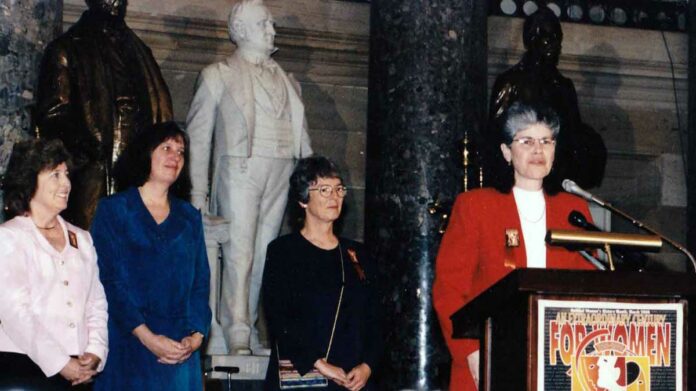
This month, we are honoring the 1980 activists who founded the National Women’s History Alliance: Molly Murphy MacGregor, Mary Ruthsdotter, Maria Cuevas, Paula Hammett, and Bette Morgan.
They recognized that women were almost absent from school textbooks—only about 3% of historical content mentioned women at the time, and their goal was to bring women’s history into mainstream education and public awareness. Their nonprofit coordinated the national campaign that led to the official recognition of Women’s History Week and later Women’s History Month.
Since 1980, women’s history is now a common part of K-12 textbooks, many schools run Women’s History Month programs, and Universities offer women’s and gender history courses and degrees. Historians have also began examining topics that had rarely been studied before, including: women’s labor and economic roles, reproductive rights movements, Indigenous and Black women’s leadership, everyday life and domestic power. The number of women in Congress has also grown dramatically, women have become leaders in business, science, and media, and in 2021, Kamala Harris became the first woman vice president.
Yet there is still work to do: many women—especially women of color, LGBTQ+ women, and women in marginalized communities—remain underrepresented in historical narratives and leadership roles. Looking ahead, Women’s History Month continues to inspire us to expand inclusion, amplify diverse voices, and ensure that all women are recognized for shaping our past, present, and future.
Highlighting women’s achievements helps reinforce the idea that women belong in positions of influence.
Photo credit: https://bohemian.com/national-womens-history-month-was-born-in-sonoma-county/