""If you don't find a way to make money while you sleep, you will work until you die." — Warren Buffett
How to draw your blended A.I./human org chart.
A founder recently told me he was drowning. Too much work, no budget to hire his way out. He needed a team, he just couldn't afford to hire one. So we built him one.
After about two hours with me, he had a team of AI agents. One agent on his main inbox, one for each of his companies. By the end, they were handing work to each other on their own.
"It figures this stuff out faster than I can type it," he said.
Most small business owners think they have a hiring problem. They're buried. Too much work, not enough hands, no budget to fix it. So they grind harder, and the growth stalls right there.
For years the only answer was payroll. Need more done, hire more people, pay more salaries, hope the cash flow holds. Not anymore.
When I say "build a team," I don't mean one giant bot that does everything. That falls apart fast. I mean an actual org chart.
You start with one main agent, your executive assistant. It knows you, your goals, your whole world. Then you add specialized agents around it. And here's the key: don't build them around roles. Build them around tasks.
Most people hire a person for a role, and that person juggles a dozen different things. Agents work the opposite way. The more microscopic you get, the better they perform. I wouldn't hire one human just to manage my email. But I'll happily run an agent that does exactly that one thing, and nothing else.
So don't start by picking software. Start by mapping the work. Take the role you wish you could hire for and break it into the actual tasks it covers. Not "marketing," the twelve specific things underneath it. Keep going until you can't reduce it further. That granular list is your real org chart, and most of those tasks don't need a human. They need an agent that does them reliably, every day, for no salary.
Your people go on this chart too. You're not replacing your team, you're completing it. Put your humans where judgment, relationships, and taste matter, the work only a person should touch. Then let agents take the repetitive tasks nobody should be spending a salary on. Same org chart. Some seats are people, some are agents.
This works whether you run one company or six, whether you have a team of fifty or a team of you. Stop waiting until you can afford the hire. Build the agent instead.
Yes, you can have agents manage subagents. But my recommendation is to build your team of agents as flat as possible. This is the mistake I made so you don't have to.
I first built my org chart deep. A main agent giving orders to sub-agents, those sub-agents reporting back up the chain. It looked impressive. It wasted my time. Every time a sub-agent got something wrong, the fix had to travel down the chain and back up. I'd tell the main agent, who told the sub-agent, who redid it. A game of telephone for one correction.
So I knocked the layers down. Now every agent answers to me directly, not to each other. Same team, far less friction.
Deep looks like a real company. Flat actually works. Build yours flat from day one.
Don't overthink the first step. Let your AI design the org chart for you.
Open your main AI assistant, the one that already knows the most about you and your business, and give it this:
"I want to build a team of AI agents to run my business so I stop doing everything myself. Here's what I do: [list your businesses, your role, and your goals]. Here's who's already on my team and what they handle: [list your people and their roles]. Interview me about the tasks that eat up my week. Then design a blended org chart: keep my people on the work that needs a human, and assign AI agents to the repetitive tasks. Build each agent around a specific set of tasks, not a job title. Keep it flat, every agent reporting to me, not to each other. For each agent, tell me what it would handle, and which one I should build first based on what's draining me most."
Answer its questions honestly. The more real context you give it, the sharper the org chart.
What you'll get back is a map: the team you've been trying to afford, drawn out, with a clear first hire that doesn't cost a salary. Build that one agent this week. Then add the next box.
This week on King Moves (What If Your Best Content Strategy Is No Strategy at All? | Ep. 137), Justin and I got into something I didn't expect to change my mind on.
I follow a very accomplished fiction author on social media, but he never pitches his books. He rarely even mentions them. He just shares sharp, random thoughts on whatever's caught his attention, pop culture, human nature, all over the map. No call to action. No "link in bio." And after watching enough of them, I went and bought his latest book anyway.
That cracked something open for me. I've spent the last year telling my team to keep my content locked on one topic: AI, AI, AI. On message. On brand. But the people we actually trust online aren't the ones running a tight content strategy. They're the ones being a whole person out loud.
We get into why authenticity is starting to beat strategy, and why "just share what interests you" might be the smartest marketing move left.
Tune in and let us know your take.
Stop playing life on hard mode. Automate your success.
Until next time,

Ethan King
A.I. Automation for Business Growth
Keynote Speaker | Author | CEO | Strategist
ethan@ethanking.com

P.S. I'm helping a few founders build out their AI org charts next week. Want to join? Just reply to this email with the word "org chart."
• • •
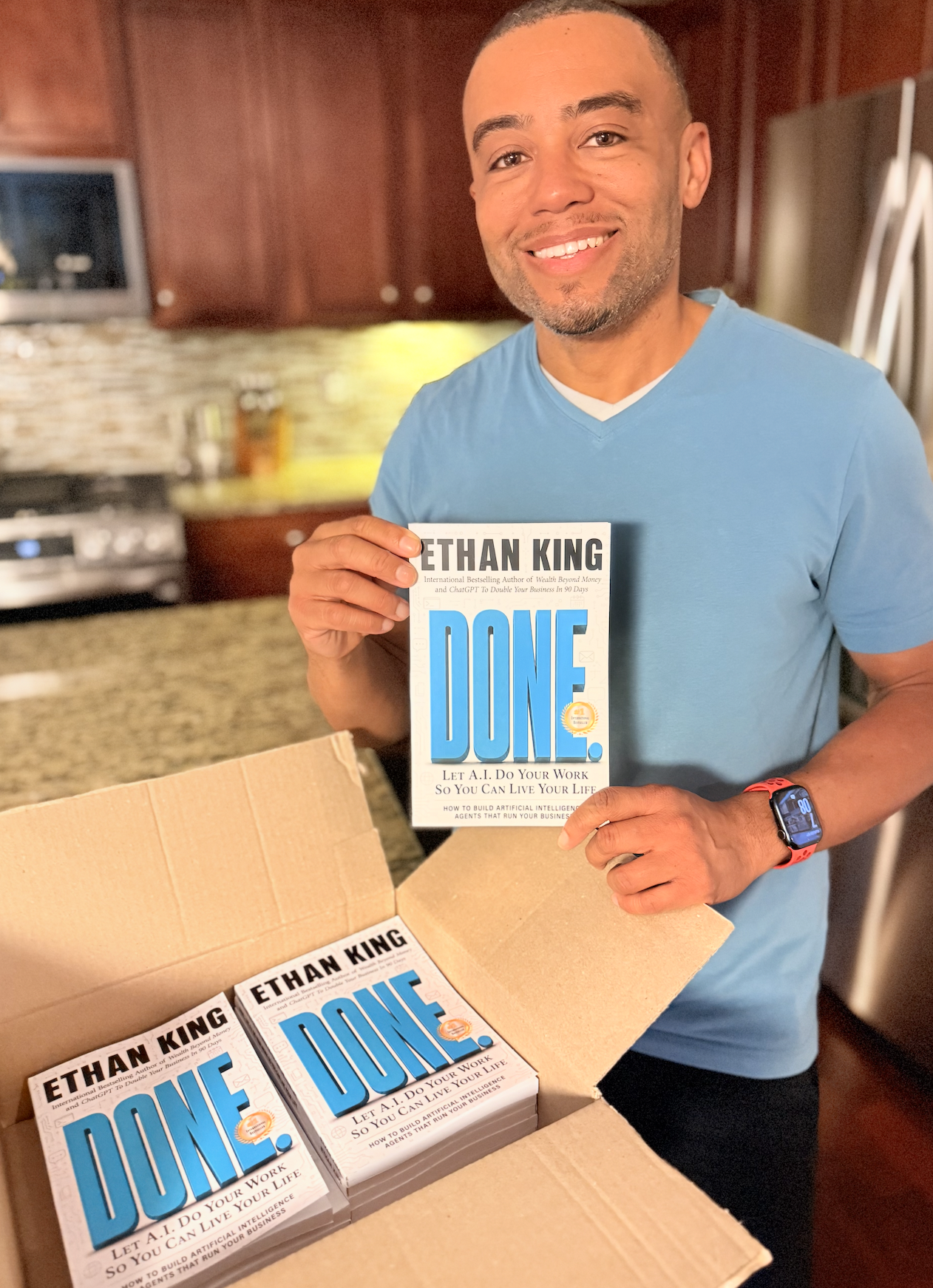
P.P.S. I felt like a kid at Christmas when I opened the first box of paperback "Done" books that came in the mail 🥹 I'm thankful that this book is impacting so many people. I hope you have had a chance to begin applying what's inside to your own business and life.
• • •
New to this newsletter? Grab past issues here.
Note: This newsletter may contain affiliate links. If you choose to purchase after clicking a link, I may receive a commission at no extra cost to you. However, please note that I only share products I actually use myself and believe in.