"Difficulties strengthen the mind, as labor does the body." – Seneca
The most powerful AI model in the world is being withheld from the public, for now. Once we get past the security risks, this brings us one step closer to autonomous AI agents conveniently running our lives. But does that trade off make us weak?
Claude Mythos is real. Anthropic's newest AI model found thousands of critical security vulnerabilities across major platforms in its first month. The UK AI Security Institute confirmed it can complete cyberattack simulations no model could touch a year ago.
Why is this important to you? Because if Mythos can find a 20-year-old bug in millions of lines of code (bugs that humans have overlooked for decades), it is obviously capable of so much more. It has elite reasoning, elite coding skills, and the ability to work autonomously for hours. When you apply those exact same traits to normal business tasks, like automating complex backend operations, building custom enterprise software from scratch, or analyzing massive datasets, Mythos represents a tool that can do the work of entire departments.
If you've been using Claude Code or OpenClaw for a while, you know how much better Opus 4.6 and 4.7 are compared to the other models. ChatGPT 5.5 just came out, which is supposed to be on par with Opus. But Mythos is not an incremental update; it is reportedly a generational leap over today's most powerful models.
This might seem unrelated, but my podcast co-host, Justin King, brought up a study on diapers. In the 1950s, babies were potty trained within 18 months. Today it takes more than three years. The reason? Cloth diapers gave immediate feedback. Babies felt the wetness. That discomfort was the signal. Modern ultra-absorbent diapers removed the signal entirely.
The technology got better. The human skill development got worse.
Now think about your life. GPS means you never memorize the route. AI means you never wrestle with the first draft. Convenience, taken to its extreme, makes you fragile. The 2026 Backslash Edges Report calls this the "Discomfort Zone." Some people are now deliberately reintroducing friction into their lives. Not because they're anti-technology. Because they realize what they're losing.
Most people think the choice is all or nothing. Use AI for everything or use it for nothing. That's not the play. The play is knowing which skills you want to keep sharp. Let AI handle the repetitive. But keep your hands on the wheel for the work that builds your judgment, resilience, and connection.
Sometimes the most strategic move is choosing the harder path when the easy one is right in front of you.
Here's your next move:
Pick one task you've been outsourcing to AI and do it yourself this week. Write the first draft. Build the spreadsheet. Map the route. Not because AI can't do it. Because you need to keep that muscle alive.
Audit your daily habits for "diaper moments." Where has convenience removed a feedback loop that used to make you better? Your phone at red lights. GPS on routes you already know. AI writing emails you should be thinking through. Identify one and reclaim it.
Set a "friction budget" for your week. Choose one deliberately harder path each day for seven days. Take the stairs. Cook instead of ordering. Write the outline before you prompt.
Track what you notice about yourself by Friday.
Stop re-Introducing yourself to AI
Problem: Every time you switch to a different AI tool or chat, you start from zero. The AI doesn't know your name, your job, or how you like to communicate. So you spend the first five minutes catching it up.
Solution: Create your own MCP server. Sounds technical. It's not.
You create a folder on your computer with a few simple text files: who you are, how you communicate, what you're working on, and any standing rules you want AI to follow. Then you connect that folder to your AI tools.
Now every AI reads your briefing before it talks to you. No more repeating yourself.
The best part? YOU own your context. Switch AI tools tomorrow and your preferences come with you.
I put together a free step-by-step guide that walks you through the whole setup in about 30 minutes. No coding required.
👉 Get the free step-by-step guide here (or tell your AI agent to read it and set it up for you)
This week on King Moves (Ep. 128), Justin and I get into Claude Mythos, the diaper study that changes how you think about technology, and why the most important skill in 2026 might be choosing when not to use AI. Perhaps the real cost of convenience isn't what you gain... it's the skills you never build. If you've ever wondered whether you're leaning on your tools too much, this one will make you think.
Stop playing life on hard mode. Automate your success.
Until next time,

Ethan King
A.I. Automation for Business Growth
Keynote Speaker | Author | CEO | Strategist
ethan@ethanking.com

P.S. If you missed our last OpenClaw done-with-you installation, join the waitlist for the next one. I'll send a poll to everyone on the list so we can determine the best day and time that works for most people 👉 youropenclawstrategy.com
It's about more than just the setup. It's the strategy.
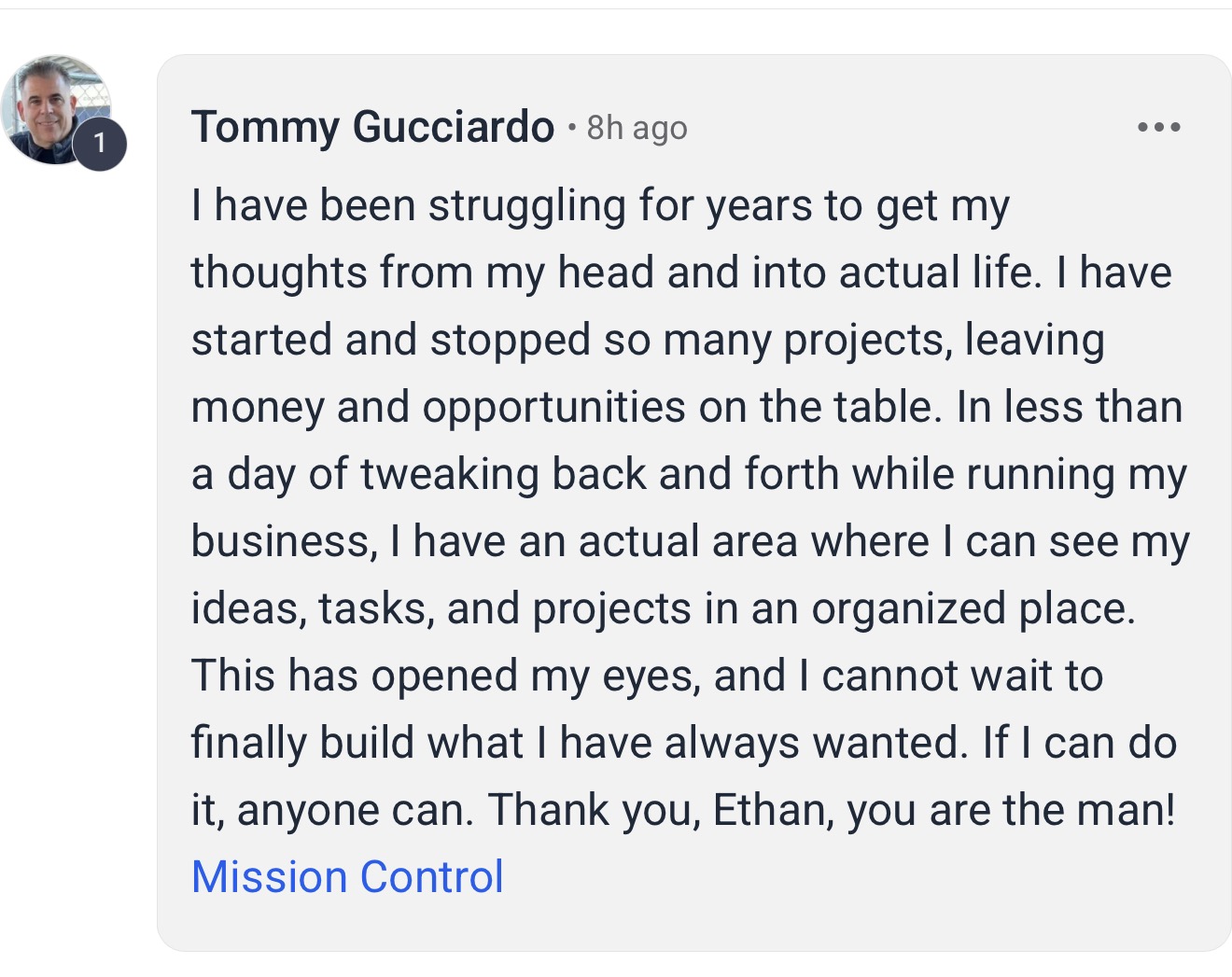
Using AI like this doesn't weaken your brain. When done right, it helps you think bigger and make sense of it all. This post from one of our newest community members made my day:
P.P.S. Many of you have asked about attending my upcoming workshops. Most of my events are private, members-only events, but there are a few coming up that are open to the public. Those registration links are below. Hope to see you at one of them.
• EO Charleston, AI Beyond the Hype Part 1, Charleston SC
• EO Nebraska, AI Beyond the Hype Part 2 (private), Omaha NE
• XPX Triangle, AI In Action: Turn AI Into ROI In Real-Time, Raleigh
• World Ticket Conference, AI Automation in Action: Your Ticket to an Unfair Advantage, New Orleans
New to this newsletter? Grab past issues here.
*This newsletter may contain affiliate links. As an Amazon Associate, I earn from qualifying purchases. If you choose to purchase after clicking a link, I may receive a commission at no extra cost to you.