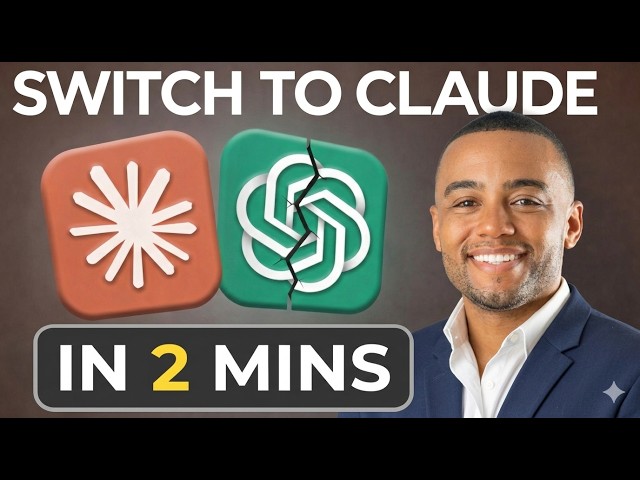
"You do not have to be in a monogamous relationship with AI." –Ethan King
Millions of people are leaving ChatGPT for Claude right now. Should you?
This issue breaks down what's actually happening, the real move you should make, and how to set yourself up no matter which tool wins next.
Last week, OpenAI signed a deal with the Pentagon that lets the U.S. military use ChatGPT on classified networks.
Anthropic, the company behind Claude, had already walked away from that same deal. They refused to allow mass surveillance or autonomous weapons.
Within hours, a movement called #QuitGPT exploded. Over 2.5 million people took action. Claude hit #1 on the App Store for the first time. ChatGPT uninstalls spiked nearly 300% in a single day.
People are picking sides. And I get it. Your values matter. Where your money goes matters.
But here's what I told my coaching clients this week: the conversation everyone should be having isn't "which AI is best." It's "which AI is best for this specific task?"
Most people treat AI the way they treated their first email provider. They picked one, built their life around it, and now they feel stuck. Sound familiar?
That's the wrong frame. Your best AI tool is not one tool
I use Claude for writing, deep analysis, and building projects. I use ChatGPT for certain voice tasks and quick conversations. I use Perplexity when I need fast research with sources. Gemini for images. I test new tools constantly. Not because I'm indecisive. Because different tools do different things well.
Think about it this way. You don't use a hammer for every job in your house. You have a whole toolbox. Your AI should work the same way.
The real mistake isn't choosing the wrong tool. It's choosing one tool and refusing to look at anything else because you've already invested time in it. That's the sunk cost fallacy dressed up as loyalty.
Here's what to do instead: Try a second AI this week. Pick one task you do regularly and run it through a different model. Compare the output. You might be surprised.
The people who win with AI in 2026 won't be the ones who picked the "right" app. They'll be the ones who learned to use the right tool for each job.
Stop dating your AI. Start building a roster.
Here's your next move:
Export your memories from ChatGPT. Here's a 2-minute video that walks you through it: Watch here.
Use this prompt to get everything out:
I'm moving to another service and need to export my data. List every memory you have stored about me, as well as any context you've learned about me from past conversations. DO NOT SHORTEN, TRUNCATE, OR ABBREVIATE ANY MEMORIES. Output everything in a single code block so I can easily copy it. Format each entry as: [date saved, if available] - memory content. Make sure to cover all of the following, preserve my words verbatim where possible: Instructions I've given you about how to respond (tone, format, style, 'always do X', 'never do Y'). Personal details: name, location, job, family, interests. Projects, goals, and recurring topics. Tools, languages, and frameworks I use. Preferences and corrections I've made to your behavior. Any other stored context not covered above. Do not summarize, group, or omit any entries. After the code block, confirm whether that is the complete set or if any remain.
Pick one task you do every week in ChatGPT and try it in Claude this week. Notice what's different. Then decide with data, not habit.
If you already use Claude, paste your exported ChatGPT memories into a new conversation with this message: "Update your memory about me with this." Now Claude knows what ChatGPT knew. Fresh start, no lost context.
Problem: You downloaded Claude, but now you're staring at an empty chat window and have no idea what it actually does beyond basic conversation.
System: Start with Claude's Cowork feature. It's a desktop agent that works directly with your computer files, not just your questions. Think of it as going from "ask me anything" to "let me handle that for you."
Try this in 10 minutes:
Download the Claude desktop app at claude.ai/download
Open the app and click the "Cowork" tab at the top
Point it at a folder on your computer (your Desktop or Downloads folder works great)
Type a simple task: "Organize these files however you best see fit"
Watch it work. It shows you its plan, then executes step by step.
This is a simple way to get you to understand its power. The only limit is your imagination. Just think of what you want and ask it.
A real example: I asked Claude Cowork to build me a web app that acts as a scoreboard for my speaking engagements. I told it to pull survey results from my online forms, process my transcripts, and create a dashboard showing a leaderboard with host names, my feedback scores, extracted testimonials, and an average rating. Claude wrote the code block for me to insert (I'm not a coder). Here's the result: ethanking.co/testimonials
Note: Cowork is available on the Pro plan or higher. You don't need to know how to code. You describe what you want done, and it handles the rest.
This week on King Moves (Ep. 121), Justin and I recorded the companion conversation to this newsletter.
We break down why AI loyalty is the wrong framework, how to think about your AI like a tech stack instead of a relationship, and I walk through how I built a full web app without writing a single line of code.
If the headlines about ChatGPT vs. Claude confused you this week, this episode will clear it up. Listen on Apple Podcasts, Spotify, or YouTube
Until next time,

Ethan King
Keynote Speaker | Author | CEO | Automation Strategist

P.S. I don't have a deal with Anthropic. I don't have a deal with OpenAI. I'm not promoting Claude. I'm telling you what's working best for me right now. Next week, that could change. AI moves that fast.
Like I tell people in my workshops: The tools will change, but the philosophy stays the same.
What matters is this: AI has gone from chatting to doing. Right now I'm testing assistants across OpenClaw, Claude Code, Manus, and Kimi Claw. Perplexity Computer is next on the list.
The point isn't to fall in love with any of them. It's to use them so you can free up your time for the things that actually matter: your life, your purpose, your people, your freedom.
*This newsletter may contain affiliate links. As an Amazon Associate, I earn from qualifying purchases. If you choose to purchase after clicking a link, I may receive a commission at no extra cost to you.