|
|
|
|
|
|
|
|
Derrick Broze (Introducción): Nuestro próximo presentador es un buen amigo mío que se ha dedicado a la organización de muchas maneras diferentes. Y cuando me siento aquí y pienso en todo lo que hemos hecho a lo largo de los años, desde las pancartas gigantes desplegadas por Filadelfia que decían a la gente que el gobierno tenía el crimen organizado y cosas por el estilo, ha sido realmente hermoso. También es autor y presentador.
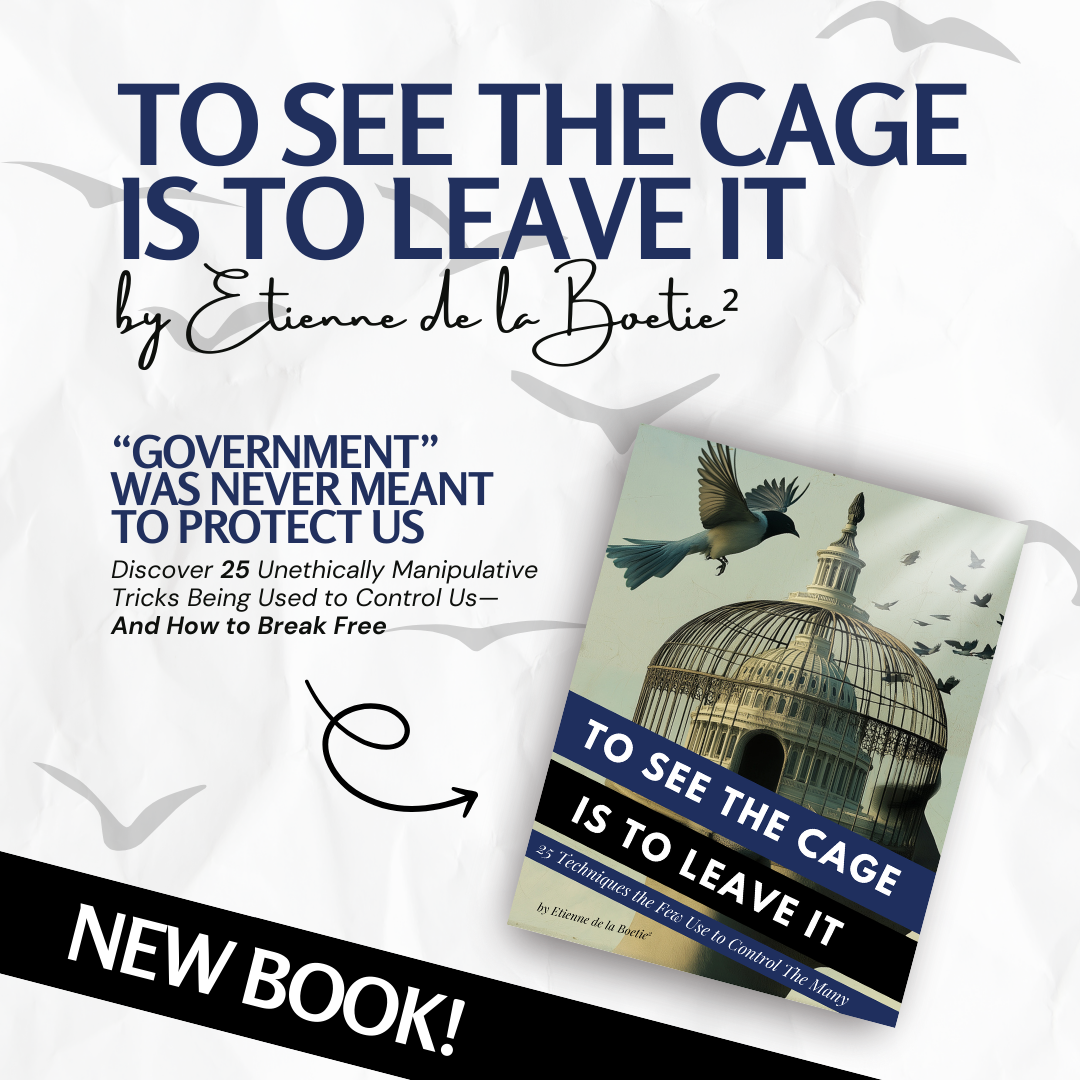
Él organiza la conferencia Liberty on the Rocks - Sedona - The Voluntaryism Conference , que tuvo lugar en Sedona hace un par de meses, además de muchas otras iniciativas importantes. Hoy nos hablará sobre el gobierno, qué es y si es necesario o no. Así que, por favor, ¡denle un fuerte aplauso a Etienne de la Boétie-Squared! Etienne de la Boetie2: Mi nombre es Etienne De La Boétie2 . Soy el fundador de la Fundación El Arte de la Libertad . Somos una organización emergente de políticas públicas que expone la ilegitimidad y la criminalidad del gobierno desde una perspectiva voluntarista basada en principios. Si no sabes qué es un voluntarista, te lo voy a explicar. Continuar leyendo... You can see this talk in English Here: https://youtu.be/0WYwgDP8Wi4 |
|
|
"Daily News of The Week”
|
|
|
|
|
by Ray Horvath, "The Source" :) Apparently, most homicides go unreported. Let me start with the old joke about the cherries, which explains the way the sliding rule works: Here is this tramp who steals a large bag of cherries. He walks down the road and gets hungry. He gobbles up some of the cherries, but there is plenty left by the time he gets sick of the cherries, so he gets angry and pees on the bag. Tired and fully content, he lies down under a tree and falls asleep. He wakes up the next morning, and he feels famished, but the only edible things around are the cherries he pissed on the previous night. He reluctantly starts taking cherries out of the bag and examines each of them closely, concluding, “This one is okay, this one is okay,” and he keeps eating them until nothing is left. These are cheap tricks, but they work, so they never go out of fashion. The masses are usually tricked into focus on one thing, while they are being robbed blind: Continue reading... |
|
|
|
|
|
|
by Alan Macleod, MPN.news As the Trump administration turns the screw on Cuba in an attempt at regime change, media are showing renewed interest in Havana Syndrome, the discredited theory that U.S. officials and secret agents are being targeted by a heretofore unknown directed energy weapon, making them sick. CBS News’ flagship political affairs show, “60 Minutes” aired another special on Havana Syndrome Sunday. The episode concentrated on profiling supposed victims of the mystery ailment, and claimed that the U.S. government had purchased a directed-energy weapon from a “Russian criminal network,” and that they had begun testing this weapon on animals. The show claimed that hundreds of American officials have been targeted by U.S. adversaries, yet the government remains reluctant to even look into the matter properly. CBS’ claims were picked up and amplified across the press, including by The Hill, MSN, The New York Post, Newsmax, AOL, and The Daily Telegraph. Continue reading... |
|
|
|
|
|
|
|
|
by Simplicius For those who thought the war could not “heat up” even more after Israel’s provocation against Iran’s largest gas field, it has apparently entered its final decisive act. After the failure of the main operational phase, wherein the US-Israeli hydra was rebuffed from inflicting any kind of decisive military defeat on Iran, we have come to the logical conclusion, where now threats of existential devastation against critical civilian infrastructure have reached the last escalatory rung. Days ago Israel launched what is presumed to be a final “warning” attack which landed mere meters from the joint Iranian-Russian operated Bushehr nuclear power plant: Yesterday Iran responded by striking in the vicinity of Israel’s Dimona nuclear plant: A CNN report captured another series of powerful blows against Tel Aviv which followed the Dimona strikes, with US-Israeli air defenses appearing totally useless: Continue reading... |
|
|
|
|
|
|
by Karen Kwiatkowski Just before the US-Israeli war on Iran went kinetic, I shared my thoughts on literal “poop” deck of the USS Gerald Ford. “T-shirts and mop heads are finding their way into the pipes, and the proper explanation is sailors are attempting to declog these post-modern shit-suckers, but a bit of old fashioned rage and frustration may also play a part. I was coy, but Colonel McGregor has not been. He assessed at the time it was sabotage “out of extreme dissatisfaction.” After 240 days at sea, the USS Ford was bound for Norfolk from the Caribbean for overdue repairs and crew changes. Most of the previous several months had been plagued with non-functioning and flooded toilets, and bad leadership. But Donald Trump decided he needed to send this battle group immediately to the Middle East, as part of a “war” buildup. Alfred Lord Tennyson spoke for these men and women: “Theirs not to make reply, Theirs not to reason why, Theirs but to do and die.”Why? In Tennyson’s poem, “Someone had blundered” and the 1854 Battle of Balaclava remains instructive, in more ways than one. Our very model of a modern Major-Generalissimo read the headline, missed the lesson, and said “Hold my beer!” Continue reading... |
|
|
|
|
|
|
by Tyler Durden New York Governor Kathy Hochul became infamous during the pandemic lockdowns for her authoritarian policies and bizarre justifications. Some may remember her viral speech to a congregation of NY Christians about how “God wants them to take the experimental Covid vaccine”. “I prayed a lot to God during this time and you know what - God did answer our prayers. He made the smartest men and women, the scientists, the doctors, the researchers - he made them come up with a vaccine. That is from God to us and we must say, thank you, God. Thank you.” “All of you, yes, I know you’re vaccinated, you’re the smart ones, but you know there’s people out there who aren’t listening to God and what God wants.“ Continue reading... |
|
|
|
|
|
|
by Lily-Rose Dawson I want you to go get your bread. The loaf on your counter, the one in your fridge, whatever you have. Flip it over and read the ingredients out loud. I’ll wait. Enriched wheat flour, high fructose corn syrup, soybean oil, mono and diglycerides, calcium propionate, and then, somewhere toward the bottom, azodicarbonamide. Which is a dough conditioner, totally normal, widely used, also the primary ingredient in yoga mats and shoe rubber. That last part is true. I did not make it up. The same chemical that gives your foam mat that satisfying sponginess is in your sandwich bread, and the FDA is fine with it, and nobody mentions it, and we all just keep eating the bread. This is where I tell you that one in three American adults is currently pre-diabetic, that type 2 diabetes rates have gone up 700% since 1960, that celiac disease has increased 400% since the 1950s. And this is where you nod and think yes, modern diet, sedentary lifestyle, personal responsibility, I’ve heard the speech. But here’s what doesn’t fit that speech: a farm laborer outside York, England, in 1324, was eating two to three pounds of bread every single day. Seventy percent of his calories. Then going outside and building cathedrals that are still standing while your knees ache on the stairs. No pre-diabetes. No gluten sensitivity crisis. No inflammatory bowel disease. Continue reading... |
|
|
|
|
|
|
by Trevor Mogg A McDonald’s in the Chinese megacity of Shanghai is testing humanoid robots in roles usually the preserve of human workers, with other types of robots also let loose inside the restaurant to greet and entertain diners. Truth be told, the robots don’t look particularly advanced, but a video (below) showing them in action does hint at a future where bipedal bots and other machines handle routine tasks at fast food restaurants, from welcoming customers and taking orders to delivering food and cleaning the floor. The McDonald’s trial, using robots supplied by Chinese firm Keenon Robotics, comes at a time of economic contradiction in China, where businesses in some sectors are struggling to hire even as millions of young people face difficulty finding work. It’s this tension that makes the McDonald’s trial stand out, with restaurant operators interested in deploying a reliable, potentially low-cost workforce in a strategy that raises fears of displacement among human workers in the service sector, which up to now has been a popular route into the workforce. Continue reading... |
|
|
|
|
|
|
by Steve H. Hanke The U.S. government is insolvent. That’s not hyperbole — it’s the conclusion drawn directly from the Treasury Department’s own consolidated financial statements for fiscal year 2025, released last week to near-total media silence. The numbers: $6.06 trillion in total assets against $47.78 trillion in total liabilities as of September 30, 2025. Importantly, the $47.78 trillion in reported liabilities does not include the unfunded obligations of social insurance programs like Social Security and Medicare — those are disclosed separately in the off-balance-sheet Statement of Social Insurance (SOSI). The government’s consolidated balance sheet position, excluding the SOSI, deteriorated by nearly $2.07 trillion between FY 2024 and FY 2025, reaching a staggering negative $41.72 trillion. Total liabilities are now nearly eight times the value of reported assets. The largest drivers were a $2 trillion increase in federal debt and interest payable (now $30.33 trillion) and a $438.8 billion increase in federal employee and veteran benefits payable (now $15.47 trillion). The off-balance-sheet picture is even more alarming. The 75-year unfunded social insurance obligation surged by $10.1 trillion in a single year, rising from $78.3 trillion in FY 2024 to $88.4 trillion in FY 2025 — driven primarily by a $6.9 trillion jump in projected Medicare Part B shortfalls and a $2.5 trillion increase for Social Security. The Treasury’s Statement of Long-Term Fiscal Projections shows the 75-year fiscal gap widening from 4.3% of GDP in FY 2024 to 4.7% in FY 2025. Continue reading... |
|
|
|
|
|
|
by Gale L. Pooley Summary: A century ago, people used large ice blocks and wooden cabinets to keep food cold. Today, electric refrigeration is more affordable, easy, and reliable thanks to technological innovation. The shift from ice blocks to electrons shows how human ingenuity can transform necessities from costly burdens into everyday conveniences. In 1925, households kept food cool with iceboxes—wooden insulated cabinets chilled by a block of ice. Depending on size and quality, they typically cost between $15 and $50. With entry-level workers earning about $0.25 an hour, a $35 icebox carried a time price of 140 hours. Today, a 4.4-cubic-foot mini fridge at Walmart sells for about $184. Entry-level workers in limited-service restaurants earn roughly $18.75 an hour, bringing the time price down to just 9.8 hours. For the time it took a worker in 1925 to earn the money for one icebox, a worker today can buy 14.3 mini fridges. Continue reading... |
|
|
|
|
|
|
by Jerm David Hughes has been on my podcast a few times and I’ve generally enjoyed his work. Back in mid-2025, for example, on my UK Column podcast, he chatted to me about psychological warfare and how to best understand it. Then, out of nowhere, a few weeks ago, he wrote a bizarre article in which he ‘outlined three camps of awareness’ and questioned my independence—hinting that I might be controlled opposition. I don’t like public spats, and I don’t consider this one to be such—since I’m critiquing his article only because he mentioned me, UK Column, and several excellent thinkers who, like David, have appeared on my podcast. Continue reading... |
|
|
|
|
|
|
by Tyler DurdenUS seeks a one-month ceasefire with a framework to end the war, according to Israel Channel 12 reports; Telegraph says Iranians see Witkoff and Kushner as ‘backstabbers’ WSJ, Fox reporting 3,000 elite Army Airborne soldiers to be ordered to Middle East. Axios says US awaits Iran response to proposed Thursday peace talks. Trump says Iran has been destroyed “militarily”. Backchannel diplomacy vs skepticism: Abbas Araghchi reportedly signaled openness to negotiations with the US via envoy Steve Witkoff, but Israel has appeared cool on deal prospects or offramp. Heavy exchange of fire and testing red lines: Iran continues missile and drone waves targeting Israel and US bases, amid reports of overnight airstrikes on military and gas infrastructure near Isfahan. Continue reading... |
|
|
|
|
|
|
by Ken Klippenstein While ICE agents are temporarily confusing things even more at airports, behind the scenes the Trump administration is paying a posse of local police to carry out its immigration war. An internal ICE financial ledger I obtained shows how the agency is turning local police departments across the county into a vast, decentralized immigration army. This includes payments if cops sign up to be deputized, reimbursements for transportation, salary supplements for cops who process migrant children, and per-arrest-style incentive payments. All of this is taking place under an ICE program called 287(g), part of a 1996 law that granted the Attorney General (and later the Secretary of Homeland Security) the authority to enter into written agreements with state and local governments on immigration. The first agreement under the law was signed by the Florida Department of Law Enforcement after 9/11; as of last year, the number of agreements has swelled past 1,000. Today, the program employs a “task force model” under which local police are deputized as ICE agents with the authority to carry out federal immigration law. So despite the broad public backlash against ICE, the agency has a way to carry out its mission without drawing attention to itself. Continue reading... |
|
|
|
|
|
|
by Joe Mullin Imagine a newspaper publisher announcing it will no longer allow libraries to keep copies of its paper. That’s effectively what’s begun happening online in the last few months. The Internet Archive—the world’s largest digital library—has preserved newspapers since it went online in the mid-1990s. The Archive’s mission is to preserve the web and make it accessible to the public. To that end, the organization operates the Wayback Machine, which now contains more than one trillion archived web pages and is used daily by journalists, researchers, and courts. But in recent months The New York Times began blocking the Archive from crawling its website, using technical measures that go beyond the web’s traditional robots.txt rules. That risks cutting off a record that historians and journalists have relied on for decades. Other newspapers, including The Guardian, seem to be following suit. Continue reading... |
|
|
|
|
|
|
by Nikita Mazurov With Immigration and Customs Enforcement agents deployed to more than a dozen airports across the U.S. and border device searches growing increasingly common, it’s more important than ever to consider your digital security before you travel. The risks are real. Customs and Border Protection agents have the authority to examine travelers’ devices. In June, for instance, federal agents denied a Norwegian tourist entry to the U.S. after looking through his phone. (Authorities claim they turned him away for admitted drug use; he says it was over a meme depicting Vice President JD Vance as a bald baby.) Immigration and Customs Enforcement have already started targeting travelers, with agents in plain clothes forcefully detaining a mother in front of her young daughter at San Francisco International Airport on Sunday after a tip from the Transportation Security Administration. If you’re flying, take these steps to reduce the likelihood that your sensitive information is compromised at the airport. Continue reading... |
|
|
|
|
|
|
By G.Calder A California jury has found Meta and YouTube liable in a landmark case on children’s social media addictions, ruling that Instagram and YouTube were negligently designed and that they failed to warn users about the risks to minors. The plaintiff, identified as KGM, said she became hooked on YouTube at six and Instagram at nine, and that the platforms contributed to depression, self-harm, and a deep deterioration in her mental health. Alongside a hefty $375 million in civil penalties imposed in a New Mexico case, jurors awarded KGM $6 million in damages, assigning 70% of the fault to Meta and 30% to Google’s YouTube, and recommended punitive damages after finding what the AP described as “malicious” disregard for the risks to children. Continue reading... |
|
|
|
|