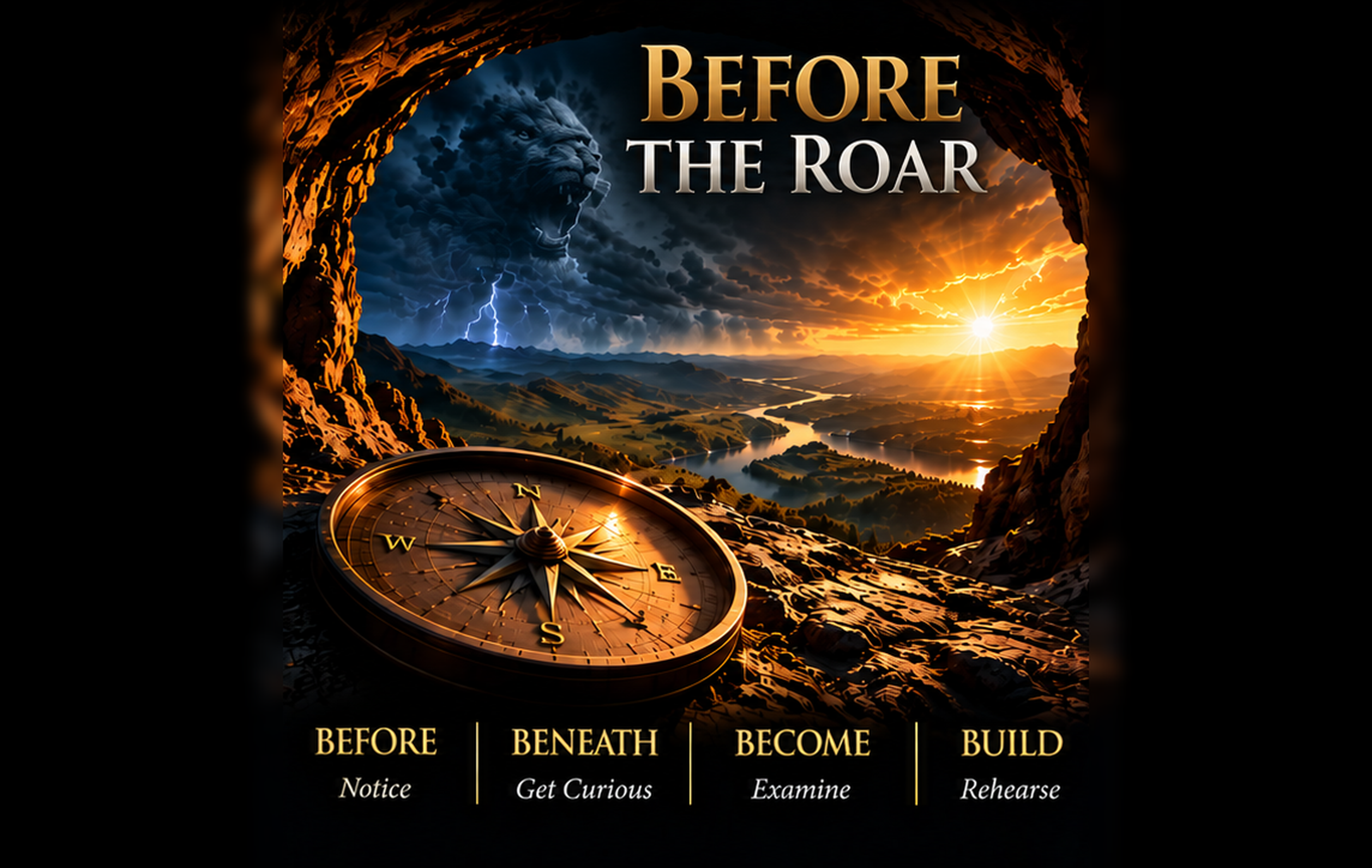
Before the Roarby John Robertson of FORTLOG |
|
|
|
|
I am so honored to be able to add an additional resource to encourage and strengthen you in leadering. You've done the training — new program, new facilitator, new binder on the shelf. Yet it's just a Groundhog Day. Look back over the last two to five years and ask honestly: what's actually different today? For most organizations the answer is uncomfortably close to "nothing." The energy that might have filled the room on training day rarely survives the drive home, and next season it's a new idea, high hopes, quick fizzle, and everyone's a little more tired and a little more skeptical than before. That's not a character flaw in your people, the training or you. It's what happens when anyone keeps reaching for the same tool and expecting a different result. Most organizations handle leadership the way most people handle our health — we wait for the headache before reaching for anything. Aspirin gets you through the day; it was never meant to build strength. Vitamins do the slower, less dramatic work of building thriving endurance before the headache ever shows up, and an organization that only ever reaches for the aspirin eventually runs out of things aspirin can fix. If training alone changed people, the last several years of programs would already show it. Just like books on leadership would have solved all the leadership issues. They don't — because training manages change. It doesn't guide it. What follows isn't another program — it's a way to see what actually grows lasting change versus what's only bought you time. Whether things are steady right now or already hard, the question underneath is the same: if training doesn't change people, then what does? That's the motivation behind Before the Roar. It's about encouragement for you, speaking to the real issues you're facing. So let's get started. |
|
|
When the Rumble Strips Become Your Steering System
|
|
|
Before — What are we seeing?Have you ever driven a vehicle that was out of alignment? It is one of the most exhilarating feelings you can have, isn’t it?
No—it isn’t.
You cannot relax your grip on the wheel. The moment you hold it lightly, the vehicle begins pulling toward the ditch or drifting toward oncoming traffic. It will certainly snap you out of whatever la-la land your mind may have wandered into.
That is why highways have rumble strips. They warn us when we are drifting toward the shoulder, crossing the centreline, or approaching a hazard. Vehicles add their own warnings: chiming alarms, flashing lights, vibrating seats and steering wheels that shake.
All these systems are designed to get our attention.
But do they solve the real problem?
Tragically, no.
They can warn us that we are drifting, but they cannot determine why we are drifting. Nor were they ever intended to become our steering system.
Yet that is how many of us get caught leading. We gradually fall out of alignment with our values. We become accustomed to the alarms. We drive over the same rumble strips repeatedly and fail to notice the effect our drifting is having on the people travelling with us.
I once rode with an older driver whose vehicle kept chiming while the steering wheel vibrated.
“I don’t know what is wrong with this vehicle,” came the complaint. “Even the crazy steering wheel keeps vibrating.”
Sitting in the passenger seat, feeling my entire body tense, I wanted to shout the answer. But I remained silent.
I knew that saying something at that moment was unlikely to help. Previous reactions had taught me that my observation would probably be met with defensiveness rather than curiosity.
These experiences are not limited to vehicles.
They also happen around leaders. The people travelling with us can see the drift. They hear the alarms and feel the vibration, but they may stop saying anything. Not because everything is fine. Silence does not mean consent.
Sometimes experience has simply taught them that speaking up will not help. |
Beneath — What is really happening?When people become silent around a leader, the silence can feel reassuring. There are fewer objections. Less disagreement. Fewer uncomfortable conversations. It may even appear that everyone is aligned.
But silence is not necessarily consent or alignment.
Sometimes silence is what remains after people conclude that honesty is not worth the risk.
The warning signs may still be there: People comply without contributing. Important information arrives late. Initiative and responsibility evaporate. The same cultural or relational problems keep returning—like Groundhog Day.
These are organizational rumble strips.
They tell us that something is moving out of alignment. But if we are focused only on the P’s—productivity, performance, protocols, procedures, paperwork— we may view those signals as annoyances rather than information. We may even blame the “stupid steering wheel.”
The deeper concern is not simply that a leader has drifted. We all drift.
|
The deeper concern is what happens when we become so accustomed to the warnings that we no longer recognize them. Or when everyone else notices the drift but no longer believes they can say anything about it. |
A leader can be incredibly productive while minimizing the relationships, conversations and cultural signals that will matter when pressure eventually comes.
That is the danger of steering by rumble strips: we may remain on the road, but we are no longer intentionally choosing our direction. |
Become — Who are we becoming?In full transparency, no one who knows me well would describe me as someone who loves administration and routine. I find many routines mind-numbing. When I become bored, distracted or overly busy, guess what happens? My own alignment begins to drift. Before long, I can find myself steering by alarms and rumble strips rather than by clarity and intention.
I need these reminders too.
Have you heard the answer to the question, “What is the key to learning?”
Repetition.
And again, I say repetition.
But repetition does more than help us remember information.
Repetition forms us.
What we repeatedly give our attention to is shaping the person we are becoming.
If we repeatedly prioritize tasks over people, we are learning to treat relationships as interruptions. If we repeatedly become defensive when challenged, others are learning to remain silent. If we repeatedly postpone difficult conversations, we are practising avoidance. If we repeatedly sacrifice our values for urgency, we are learning that our values are negotiable whenever pressure rises.
|
That is why being a shepherd-guide is never passive. Leadering is not formed only in defining moments. It is shaped through the ordinary repetitions that come before them. |
Pressure may reveal who we are, but repetition helps determine who will be there to be revealed. |
So perhaps the question is not only, “How will I respond when the roar comes?”
A better question may be:
Are my repeated behaviours producing the person people will need when the roar comes?
And are they producing the person I want to be when it does? |
|
|
Build — What can we practise now?Think about what you have repeated over the last week or two.
Not what you intended to do. Not what your values statement says you believe. Look instead at what you have consistently given your attention, energy and emotional reactions to.
What have you been practising?
Perhaps you and I have repeatedly: rushed conversations, avoided a person or issue, reacted defensively to unwanted feedback, or repeatedly allowed the urgent to crowd out what is important.
Now consider the people travelling with you.
What might they be seeing, hearing or feeling that we have stopped noticing? What have they attempted to tell us? Where might their silence be communicating something their words no longer do?
Please do not try to overhaul everything today.
Choose one repeated behaviour that is moving you out of alignment and replace it with one intentional practice.
Pause before responding. Ask one more question. Put the phone down. Invite someone to tell you what you may not be seeing. Return to the conversation you have been avoiding. Name the value that should guide your next decision.
And when you hear the rumble strip, do not blame the road, the vehicle, or dismiss the passenger.
Become curious.
|
The warning is not the enemy. It may be the very thing that helps you realign before the critical moment arrives. |
Because rumble strips can alert us to drift— but they were never meant to steer the vehicle.
What we repeat, we rehearse. What we rehearse, we become.
Build today what people will need from you when the roar comes.
Build today what you need to be when the roar comes.
|
In Service, John R. Robertson Founder of FORTLOG Services and best-selling author of Run Toward the Roar and Living the I AM in an I HAVE Culture |
|
|
My Gift to You
|
As a leader, sometimes it's hard to know who is in your court, giving you an outside perspective and helping you navigate the challenges of leadership. I'd love to have a conversation with you about where you are and how you can grow forward, for you and for your team. No strings attached - just a real conversation and next steps. |
|
|
|
|
|
|
Dive Deeper
|
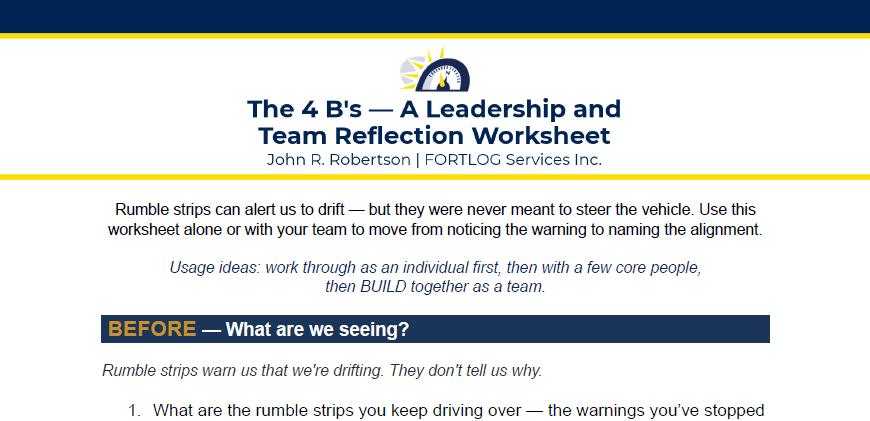
I've created a worksheet that helps you walk through the process outlined here in the 4 B's. I recommend working through it personally first, then with a few core individuals, and then with your team. |
|
|
|
|
Are You or Someone You Know Looking for a Speaker?
|
I'm currently booking speaking and consulting dates for the fall and winter. I speak on critical moments like crisis, growth, and change, where navigating leadership and team culture are not optional or delayable decisions. Let's connect about how I could serve your event or team? |
|
|
|
|
Want Help Building Your Huddle?
|
A huddle is not a mastermind group. Not a therapy session. Not another meeting.
It is three to five peers who carry real responsibility — people in the game, not in the stands — meeting regularly with one purpose: to help each other move forward.
If you’ve been thinking about starting one, or if you lead a team that needs this kind of peer accountability built into their rhythm, reach out to hello@fortlog.co and let’s talk about what that looks like for your context. I can help you design and launch it. |
|
|