Run Toward the Roarby John Robertson of FORTLOG |
|
|
|
|
It’s Not About Being Right; It’s About More
|
Let me start with a confession, because it’s the honest way into this. A friend — I’ll call her Kelly — was in the middle of ‘informing’ her daughter about a red-light-camera ticket that had come in the mail. "How could you do that? Why would you not stop?" The daughter kept pushing back: "I didn’t do it." It wasn’t helping. And then Kelly remembered that particular day, her own car was in the shop. She’d been driving her daughter’s. She was the one in the photo. She told me she stood there for a second weighing two options: admit it or quietly sweep it under the rug. She laughed as she told me. But that pause, that’s the whole thing right there. It reminded me of a red-light ticket that once landed at our house. My wife and I looked at each other, looked at the ticket, said nothing, and we both pulled up our calendars to work out who’d been driving. She smiled first: “Well, it wasn’t me in the vehicle that day.” Same small moment of truth. Same fork in the road. |
Because the mistake I keep having to own isn’t always a bad decision I defended. Sometimes it’s a moment I stayed quiet. |
I saw something, knew what I thought about it, and said nothing, because somewhere between what I knew and what I was willing to say sat a quiet calculation: if I speak, who am I going to upset? I didn’t want to wake up the next morning wondering who I’d ticked off. So, I honoured the peace instead of the truth and told myself that silence was diplomacy. Here’s what I’ve had to learn the hard way. Silence in those moments isn’t neutral. It’s a call. And it’s often the wrong one. So here’s the only question that matters, whether your miss was something you did or something you left unsaid: what do you do with it now? Most leaders do one of two things, and both are quiet trust destroyers. They defend it, building the case for why it was actually fine. Or they bury it, never mention it again and hope the organization’s short memory does the work. Both are the same instinct: protect the image. And both cost you the one thing any human can least afford to lose — the trust of people who already know what happened and are just waiting to see if you’ll be honest about it. There’s a third option. You correct it. Out loud. Without shame. And there’s a sequence to doing it cleanly, one that doesn’t leave you groveling, over-explaining, or turning a course-correction into some guilt parade to beat yourself up in public. |
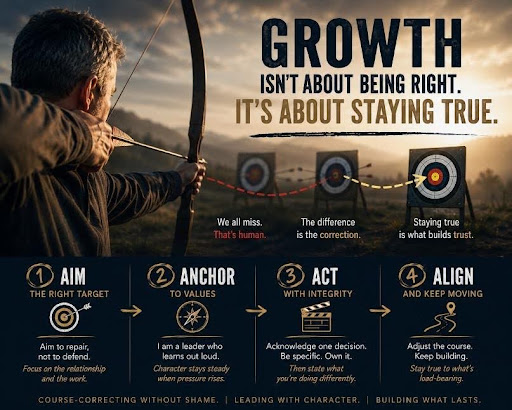
Aim — Repair, don’t defendBefore you ever say a word, be brutally honest about what you’re actually trying to accomplish. Because the goal of a course-correction is not to feel better. It’s not to be forgiven. It’s not to win back approval. The goal is repair. |
Defending aims at your image. Repairing aims at the relationship and the work. Those are different targets, and you can’t hit both with the same shot. |
The moment your aim drifts toward “make me look acceptable again,” you’ll start hedging and qualifying. Then your people will hear all of it as a defence wearing the costume of an apology. So, name the aim before you open your mouth: I am here to repair what my decision affected, not to protect how I look while I do it. That’s the difference between “Here’s why it wasn’t really my fault” and “Here’s what I got wrong and what I’m doing about it.” Same situation. Completely different leadership. A caution worth naming here: going first can draw out the finger-pointers, those experts in the stands who never risk anything themselves. Aim to grow forward, not to hand them ammunition. (This is a whole article of its own, and one we’ll come back to.) |
|
|
Anchor — I am a leader who learns out loudThis is where most corrections fall apart. The leader tries to course-correct without a values-based anchor, and the moment it gets uncomfortable, someone looks disappointed, or asks a hard follow-up, they reach for defensiveness, because they’ve got nothing to hold onto. The anchor is identity. Not “I am a leader who is always right” — that one snaps the instant you’re wrong, which is exactly when you need it most. The anchor is: I am a leader who learns out loud. Take a moment and think about what that does. If being someone who learns out loud is who you are, then admitting a mistake isn’t a deviation from your leadership; it’s an expression of it. You’re not stepping out of character to apologize. You’re stepping fully into it. |
People don’t follow you because you’ve never been wrong. They follow you because of who you are when you are. |
This is the shift from I HAVE to I AM. An I HAVE leader is anchored to what they possess (the title, the credentials, the track record) and a mistake threatens all of it. An I AM leader is anchored to who they are, and who they are was never “flawless.” It was “true.” That’s where your authority actually lives, not in your accuracy, but in your character-based conduct. Anchor there, and you can course-correct all day without losing an ounce of standing. |
Act — Acknowledge one decision, specificallyNow you act. And the discipline here is specificity. A vague apology is almost worse than none. “Mistakes were made, we’re all learning, nobody’s perfect.” That’s not ownership, that’s fog. It names nothing, owns nothing, and changes nothing. So, act small and exact. One decision. “I made this call. Here’s what I see now that I didn’t see then. Here’s what I’d do differently.” Name the actual decision, the actual gap, the actual adjustment. That’s the whole move. And resist the urge to make this into some production, that’s its own form of self-protection. The leader who turns one mistake into a sweeping confession of inadequacy isn’t being humble; they’re making the moment about their feelings instead of the repair, and forcing the team to reassure them. One decision, named cleanly, then forward. That takes more character than the grand gesture, because it’s honest without being indulgent. This is also where you go first. Don’t wait for the performance review, the exit interview, or the grapevine to force your hand. The leader who names it before anyone asks controls whether this is an act of integrity or a confession extracted under pressure. Same words. Entirely different meaning. |
Align — Did the ownership build trust?The last A is the check. You came to repair, did it? You can’t know that from inside your own head, because from in there, you’ll just feel the relief of having gotten it off your chest. Alignment asks the harder question: did this land as ownership for the people it was meant for? Watch what happens next. Does the team seem freer, or more wary? Did naming your mistake make it safer for someone else to name theirs? Real ownership has a tell: the room exhales. The tension everyone was quietly carrying releases, because the thing they all knew finally got said by the one person who needed to say it.
Consider what the absence of that check costs. An arborist crew I know of kept passing over their highest performer for an inspector role, three times. Each one resulted with feedback too vague to act on, the job going to someone more junior each round.
Nobody ever stopped to ask the fourth A question: did that decision build trust, or drain it? It drained it. The performer left, took a colleague, and started a competing company that had already lined up contracts. The ones who stayed now work exactly to the hours on the schedule and not a minute more. The callbacks after the storm go unanswered. The decision was never revisited, so it quietly rewrote the whole culture. That’s what un-checked ownership looks like: not one dramatic failure, but a slow leak nobody named until the best people were gone. And if your correction lands flat — or worse, lands as fishing for reassurance — that’s information, not failure. It usually means the aim drifted, the act got vague, or the anchor slipped. Run it back through. |
Course-correcting your course isn’t weakness. It’s the whole point. This was never about getting it perfect. It was about staying true. |
|
|
You don’t tear a building down to the studs every time something cracks. That’s not improvement — that’s destruction wearing improvement’s clothes. You stay true to what’s load-bearing, and you honestly fix what’s broken. That’s repair. That’s leadership. And it’s the difference between a culture where people hide their mistakes and one where they finally feel safe enough to grow. So this month, find the one decision you’ve been defending or the one true thing you’ve been leaving unsaid. Aim to repair it. Anchor in who you are. Act on it, specifically and out loud. Then check whether the trust deepened. It will. It almost always does. Because your people were never asking you to be right. They were asking you to be true. |
John Robertson FORTLOG Services Inc. |
|
|
Dive Deeper
|
This month’s Run Toward the Roar podcast episode explores further how we can course-correct without shame. If there is a decision you've been quietly defending or if you're determining next steps forward to grow team trust, this episode is for you. There's also a number of previous episodes available on a variety of topics, so please take a look through them and see what other episodes would be helpful for where you and your team are today. |
|
|
|
|
Are You or Someone You Know Looking for a Speaker?
|
I'm currently booking speaking and consulting dates for the fall and winter. I speak on critical moments like crisis, growth, and change, where navigating leadership and team culture are not optional or delayable decisions. Let's connect about how I could serve your event or team? |
|
|
|
|
A Next Step Resource For You
|
Are you an I AM or an I HAVE leader? I've created a triage assessment that helps you determine where you are and grow forward. The quiz only takes a few minutes, but it might just change how you see yourself as a leader and give you clarity on your next step. |
|
|
|
|
Want Help Building Your Huddle?
|
A huddle is not a mastermind group. Not a therapy session. Not another meeting.
It is three to five peers who carry real responsibility — people in the game, not in the stands — meeting regularly with one purpose: to help each other move forward.
If you’ve been thinking about starting one, or if you lead a team that needs this kind of peer accountability built into their rhythm, reach out to hello@fortlog.co and let’s talk about what that looks like for your context. I can help you design and launch it. |
|
|