MEDICAL MINUTE
David and the Goliaths: The Three-Headed Monster That Ate American Health
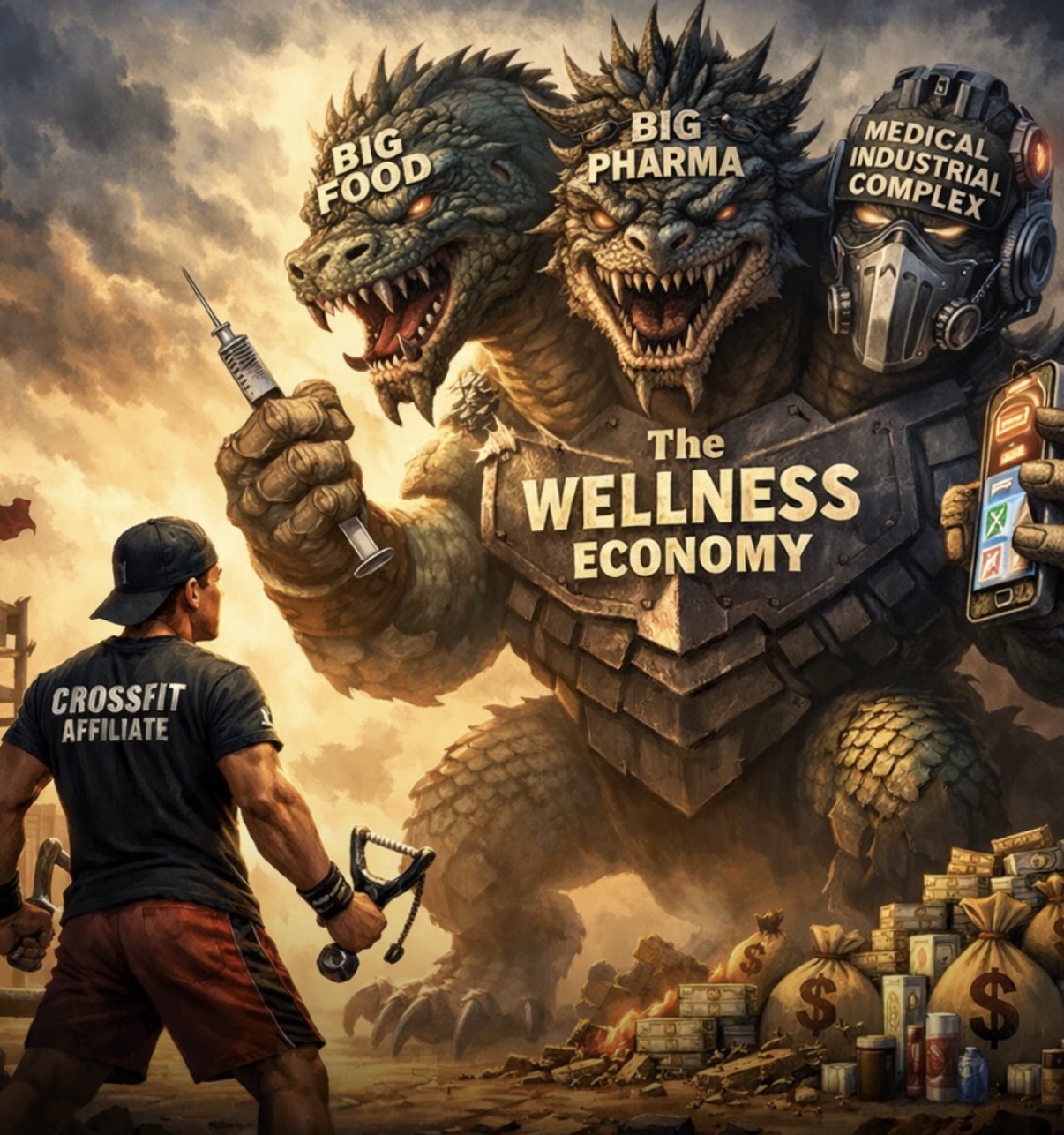
We are living inside a battle between Davids and Goliaths. But this time, the Goliaths aren’t made of flesh and armor, they’re vast, soulless conglomerates of Big Food, Big Pharma, and the medical-industrial complex, all chained together by the invisible hands of insurance. Together they form a three-headed monster that feeds on human potential and sells it back to us as “healthcare.” It manufactures sickness, monetizes survival, and manipulates trust. And yet, standing small but unshakable in its shadow is the modern David: the CrossFit affiliate. Chalk-covered, scrappy, and fiercely human, the affiliate isn’t just a gym; it’s a rebellion. It’s where movement becomes medicine, and community and culture becomes cures.
The Monster’s First Head: Big Food and the Business of Decline
The first head of the monster smiles through commercials and colorful packaging. The industrial food complex engineers palatability, not nourishment. It studies our brains like a market map, tweaking salt, sugar, and fat ratios to hijack dopamine and guarantee dependency. These aren’t meals; they’re manufactured habits. Subsidies reward processed ingredients over real nutrition, advertising budgets target children long before they can spell the word metabolism, and corporate funding seeps into the very science meant to protect us. Where metabolic disease is not an epidemic, but rather a business model. Big Food’s balance sheets depend on chronic illness the way the lungs depend on air. The worse we eat, the better they do. And every can, box, and bar moves us one step closer to the waiting arms of the next head.
The Monster’s Second Head: Big Pharma and the Machinery of Maintenance
When the first head has done its work, the second steps forward wearing the costume of salvation. Big Pharma promises relief, longevity, control. It tells us that health can be swallowed, injected, or prescribed. But this is a modern inversion of medicine’s oldest ethic. Hippocrates warned that the role of the physician was not merely to intervene, but to understand the causes of illness and first, to do no harm. Medicine, in its original form, was inseparable from lifestyle, environment, movement, and daily habit. It was rooted in observation, restraint, and humility.
What we practice today often looks nothing like that tradition. Disease is no longer something to be resolved, but something to be lived with indefinitely. Pharmaceutical companies have mastered the art of dependency. When medication becomes the default response to conditions born from environment, diet, stress, and inactivity, medicine abandons its own philosophical roots. We are no longer asking, “What does this person need to become well?” We are asking “What can we prescribe to keep this manageable?” Hippocrates viewed health as a state of balance, maintained through daily practice and personal responsibility, supported, not replaced, by the physician. Big Pharma doesn’t defeat disease; it domesticates it. It teaches us to live comfortably inside dysfunction while selling the illusion of progress. But no matter how many medications we take, the underlying problem remains the same: a society sick by design, pacified by prescriptions, and placated by policy.
The Monster’s Third Head: Insurance and the Strangulation of Care
The third head is quieter than the others, but far more sophisticated. It inserts itself between people and care, reshaping how health is accessed, delivered, and valued. Insurance was originally conceived as a mechanism for shared risk, a financial safeguard against catastrophe. Over time, it has evolved into something else entirely, a powerful intermediary that determines the terms of care itself. By deciding what is reimbursed, how care is delivered, and which interventions are deemed “appropriate,” insurance has become an invisible architect of modern medicine. For patients, it’s a maze of deductibles, denials, and deception. For providers, it’s a vise grip on time, purpose, and humanity. The average physician spends nearly twice as many hours on documentation as on direct patient care. They chase codes instead of cures, argue for reimbursement instead of results, and learn that the fastest way to lose a day is to try to help someone too much. This system doesn’t incentivize prevention. Instead, it punishes it. An hour teaching a patient about nutrition or strength training isn’t reimbursed the way a diagnosis or procedure is. The system rewards reaction, not resolution. It’s a perverse economy where sickness is profitable and health is unsustainable. The cost isn’t just financial, it’s moral. Providers are burning out in record numbers not because they are weak, but because the system is violent to those who care. They enter medicine to heal and instead are trained to document, defend, and justify their decisions to entities that have never laid hands on a patient.
When the System Devours Its Own
The three heads feed each other in a cycle so efficient it’s almost elegant: Big Food manufactures dysfunction; Big Pharma monetizes it; insurance and the medical-industrial complex manages it. Together they keep the wheel turning, extracting value from every lab result, every diagnosis, every appointment. This is not a healthcare system, this is a health-extraction industry. Here’s the irony: in its greed, the system has created the perfect conditions for rebellion. The more it controls, the more people seek freedom. The more it commodifies care, the more people crave connection. The more it suffocates providers, the more they search for places to practice with purpose again.
Enter the CrossFit affiliate.